
The biogas and renewable natural gas (RNG) industry has seen significant growth in recent years.
New facilities continue to come online, investment is increasing, and demand for renewable energy remains strong.
Yet across the industry, a consistent issue persists:
Many biogas systems are underperforming relative to their potential.
The Performance Gap
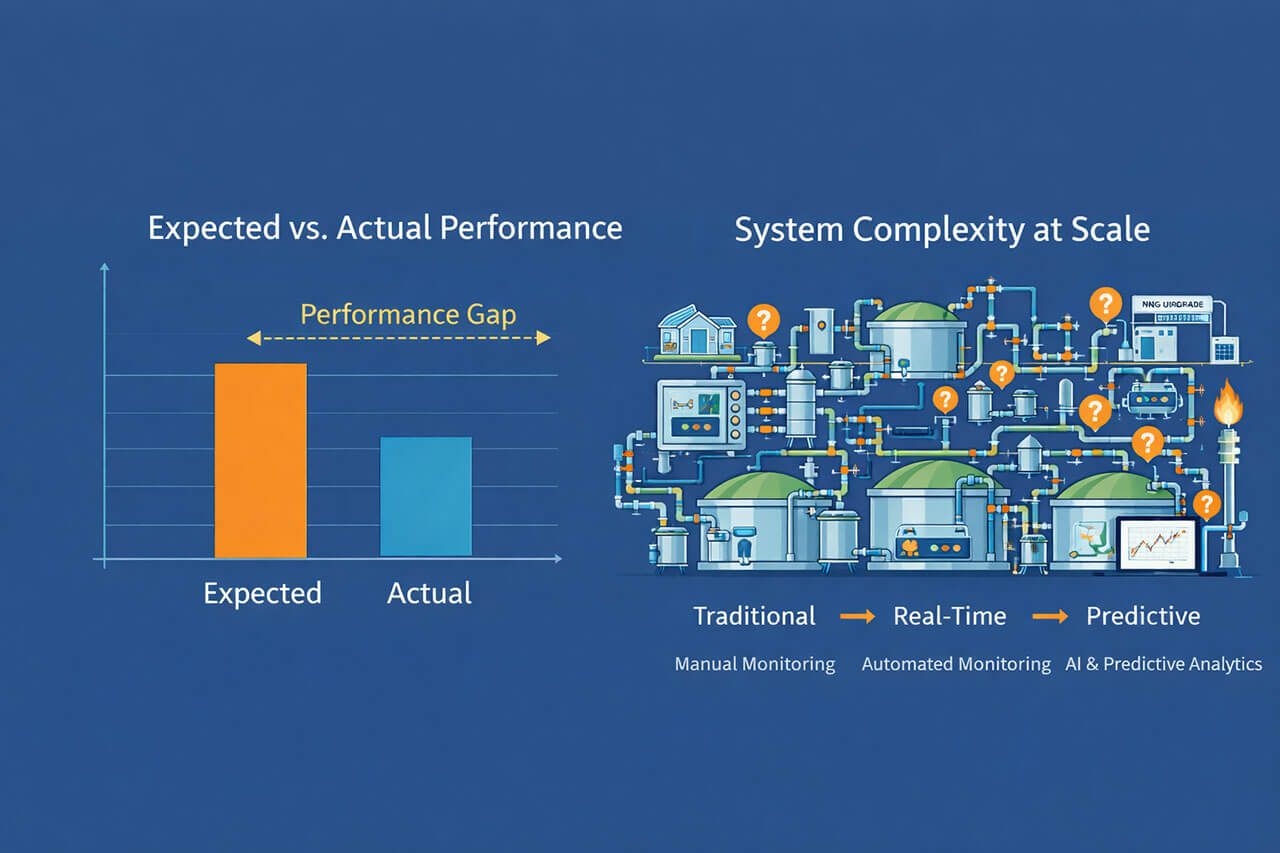
On paper, many facilities are designed to achieve specific output levels, efficiency targets, and financial returns.
In practice, however, actual performance often falls short.
This gap between expected and actual performance is not always obvious—but over time, it can have a significant impact on:
- Methane production
- Operational stability
- Revenue and return on investment
Explore how performance impacts ROI
Complexity at Scale
As biogas systems grow larger and more complex, managing performance becomes increasingly challenging.
Understanding anaerobic digestion helps illustrate why—these systems depend on sensitive biological processes that are influenced by constantly changing conditions.
At scale, small inefficiencies can compound into larger performance issues.
The Hidden Drivers of Underperformance
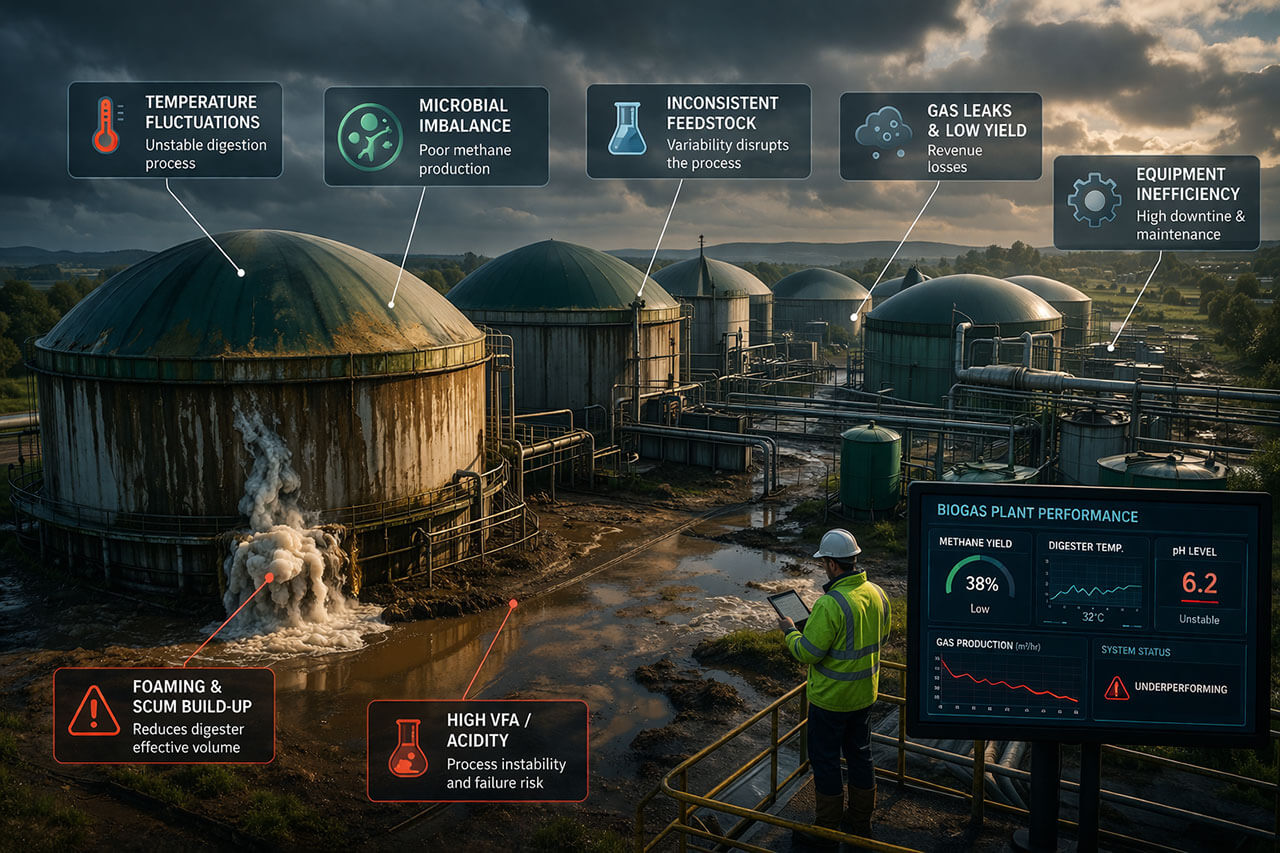
Underperformance is rarely caused by a single issue.
More often, it results from a combination of factors that interact over time.
Feedstock Variability
Changes in feedstock composition can disrupt biological balance and reduce system efficiency.
Limited System Visibility
Without real-time insight, operators may not detect issues until performance has already declined.
Explore monitoring approaches
Reactive Decision-Making
Many facilities rely on delayed data or periodic testing, which limits the ability to respond proactively.
Operational Constraints
Manual processes and limited automation can make it difficult to maintain consistent operating conditions.
The Cost of Underperformance
Underperformance is not just a technical issue—it is a financial one.
Even modest inefficiencies can result in:
- Reduced energy output
- Increased operating costs
- Greater system variability
- Lower long-term returns
For investors and operators alike, performance consistency is critical to achieving expected outcomes.
Why the Problem Persists
Despite advances in technology, many facilities continue to operate using traditional approaches.
This is often due to:
- Legacy system design
- Limited access to real-time data
- Fragmented operational processes
As a result, performance issues may go unaddressed—or be addressed too late.
A Shift Toward Performance-Centric Operations
The industry is beginning to move toward a more performance-focused model.
This shift is driven by:
- Increased competition
- Greater scrutiny from investors
- The need for more predictable outcomes
Facilities are starting to prioritize not just output—but how efficiently and consistently that output is achieved.
The Role of Data and Analytics
Improving performance at scale requires better visibility and control.
Understanding data analysis highlights how structured data can reveal patterns and opportunities that are not visible through manual observation.
Data-driven systems allow operators to:
- Monitor performance continuously
- Identify inefficiencies early
- Adjust operations in real time
From Reactive to Proactive Management
One of the most important shifts in modern biogas operations is the move from reactive to proactive management.
Instead of responding to problems after they occur, operators can:
- Anticipate instability
- Optimize inputs and processes
- Maintain more consistent performance
See how predictive systems support this shift
Closing the Performance Gap
The gap between expected and actual performance is not inevitable.
It can be reduced—and in many cases eliminated—through better visibility, improved decision-making, and more consistent system control.
Facilities that prioritize these areas are better positioned to:
- Increase methane production
- Improve stability
- Maximize return on investment
What This Means for the Industry
As the biogas sector continues to grow, underperformance will become harder to ignore.
Operators, investors, and stakeholders will increasingly focus on:
- Measurable performance outcomes
- Operational consistency
- Data-driven optimization
Those who adapt will lead the next phase of industry development.
Moving Toward More Predictable Systems
Improving performance at scale is ultimately about reducing variability and increasing predictability.
With the right tools and approach, biogas systems can operate closer to their full potential—delivering more consistent output and stronger long-term results.
Explore how Nirova supports performance optimization