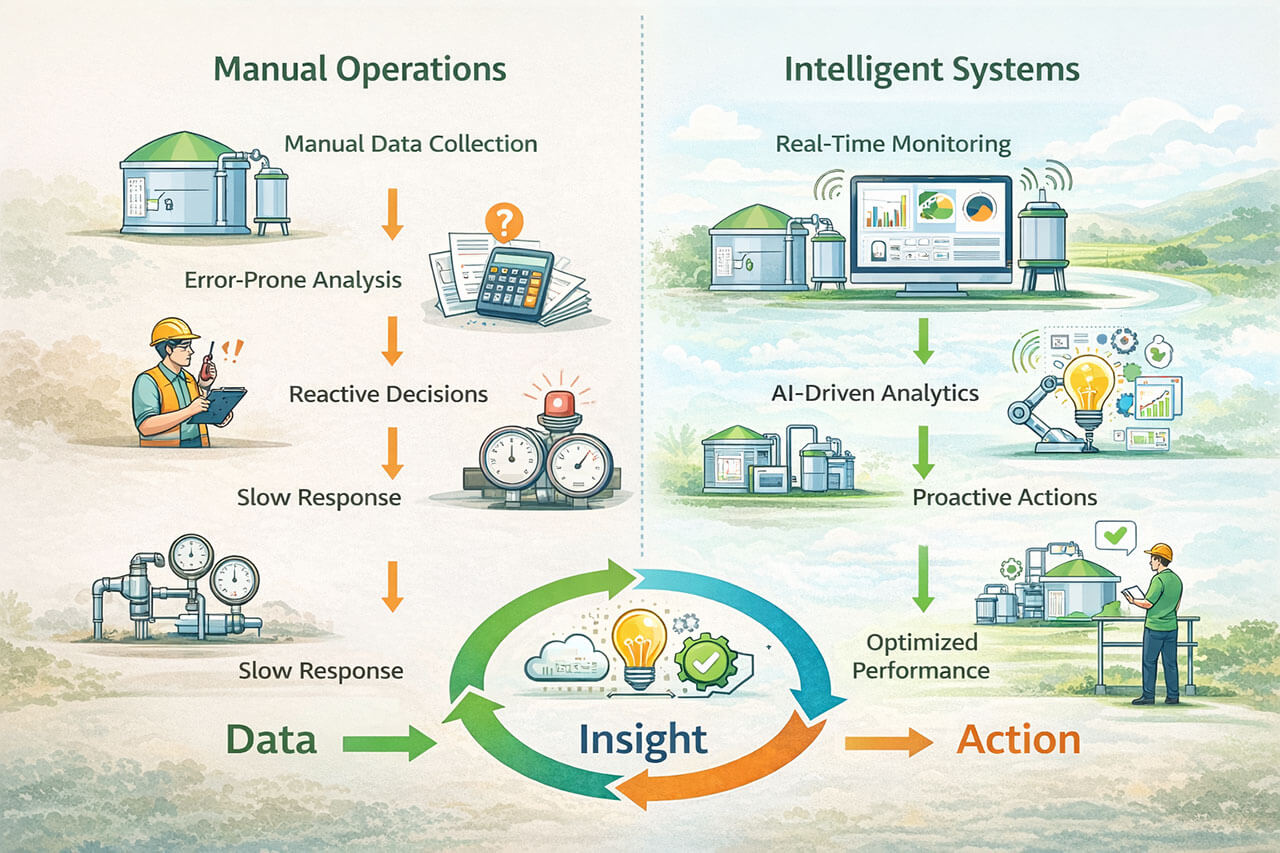

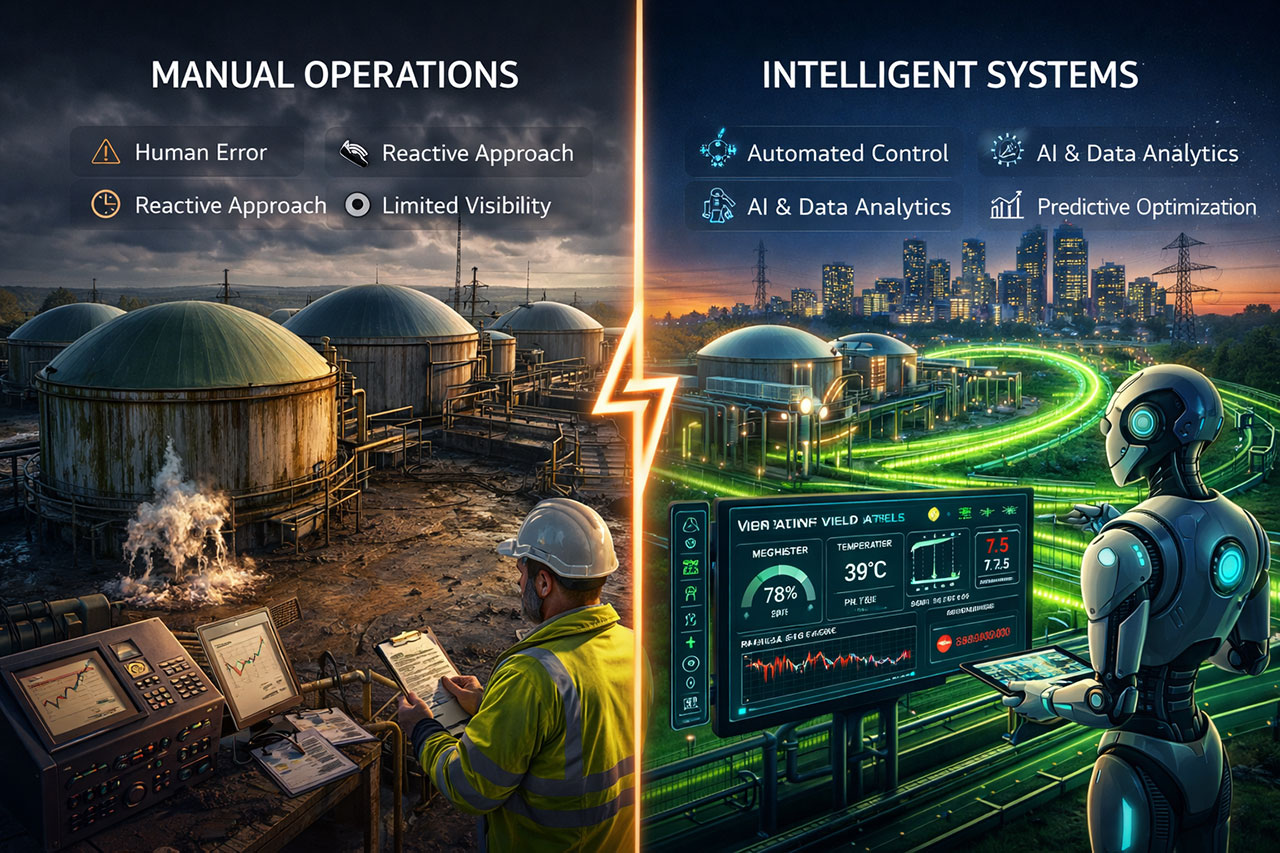
Biogas operations are undergoing a fundamental shift.
For years, most facilities have relied on manual processes, periodic testing, and operator experience to manage system performance.
While these approaches have enabled growth, they are increasingly reaching their limits.
A new model is emerging—one defined by intelligent, data-driven systems.
The Legacy of Manual Operations
Traditional biogas systems are often managed through:
- Scheduled lab testing
- Manual adjustments to feedstock and loading rates
- Operator intuition based on historical patterns
These methods can work—but they are inherently reactive.
Operators typically respond to issues only after they appear, rather than preventing them in advance.
The Limitations of Reactive Management
Anaerobic digestion systems are highly dynamic.
Understanding anaerobic digestion highlights how sensitive these biological processes are to changes in input and operating conditions.
When decisions are based on delayed or incomplete data, it becomes difficult to:
- Detect instability early
- Maintain consistent system conditions
- Optimize performance in real time
The Emergence of Intelligent Systems
Intelligent systems combine real-time data, analytics, and automation to improve how biogas facilities are managed.
These systems enable operators to:
- Monitor performance continuously
- Identify changes as they occur
- Respond more quickly and effectively
The result is a shift from reactive operations to proactive management.
From Data to Decision-Making
Collecting data is only the first step.
The real value comes from turning that data into actionable insight.
Understanding data analysis shows how structured data can reveal patterns that are not visible through manual observation alone.
Intelligent systems help operators:
- Interpret complex system behavior
- Identify trends and anomalies
- Make more informed operational decisions
The Role of Predictive Intelligence
The next stage in this evolution is predictive capability.
Understanding predictive analytics provides context for how systems can anticipate future conditions based on historical and real-time data.
With predictive insights, operators can:
- Anticipate instability before it occurs
- Adjust inputs proactively
- Reduce variability and risk
Automation and Consistency
Intelligent systems also support more consistent operations through automation.
Rather than relying entirely on manual intervention, facilities can:
- Standardize processes
- Reduce variability in decision-making
- Maintain more stable operating conditions
This consistency is critical for improving long-term performance.
Impact on System Performance
The shift toward intelligent systems has measurable effects on performance.
Facilities that adopt these approaches can achieve:
- Increased methane production
- Improved system stability
- Reduced operational risk
- Greater efficiency
See how monitoring supports performance
Changing Expectations Across the Industry
As intelligent systems become more common, expectations are changing.
Operators and investors are beginning to expect:
- Continuous visibility into system performance
- Data-driven decision-making
- More predictable and consistent outcomes
Facilities that continue to rely solely on manual processes may find it harder to compete.
Bridging Experience and Technology
This shift does not replace operator expertise—it enhances it.
Experienced operators remain essential.
However, intelligent systems provide the tools needed to:
- Support better decisions
- Reduce uncertainty
- Improve overall system control
The Path Forward
The transition from manual to intelligent operations is not instantaneous.
It requires:
- Adoption of new technologies
- Integration of data systems
- A shift in how decisions are made
Facilities that make this transition early will be better positioned for long-term success.
Building Smarter Biogas Systems
The future of biogas operations will be defined by systems that are:
- More connected
- More responsive
- More intelligent
These systems will enable operators to manage complexity more effectively and achieve more consistent results.
Explore how Nirova supports intelligent operations
A New Standard for Operations
The move toward intelligent systems is not just a trend—it is becoming the new standard.
As the industry evolves, the ability to leverage data, analytics, and automation will define which facilities lead—and which fall behind.